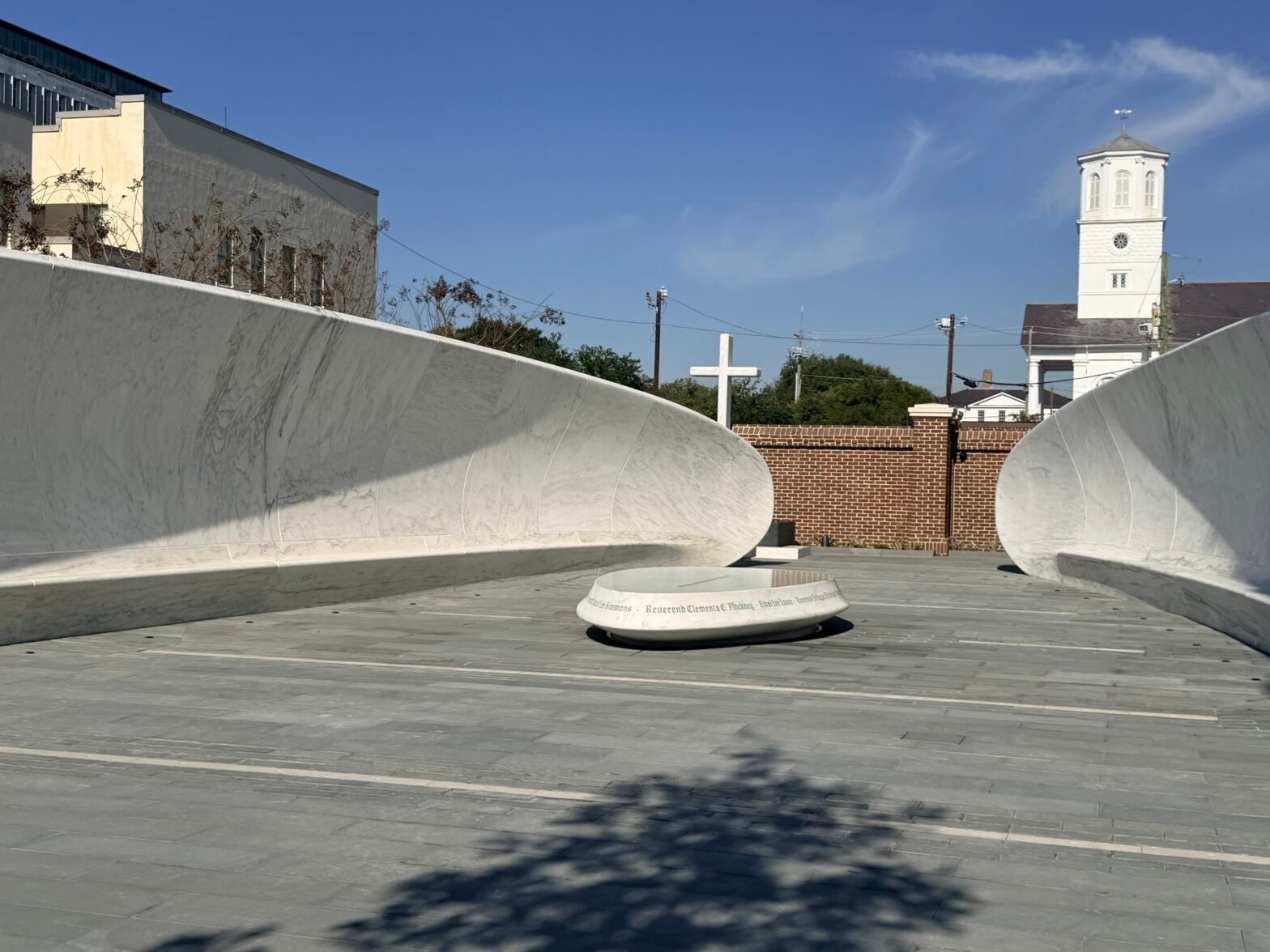
A few days before the Emanuel Nine Memorial opened to the public, a small group of Black journalists walked into what used to be the parking lot of Mother Emanuel AME Church on Calhoun Street in Charleston, South Carolina. The area beside the church is now called the Memorial Courtyard. The first thing we noticed was the white marble Fellowship Benches, a perfect match for the church’s iconic white stucco façade. At first glance, the two long, curved benches look like angel wings. Others in our group said they look like two arms pulling you in for a hug.
The centerpiece, known as the Fountain of Grace, also captivated us at first sight. A cross is carved into the middle of the marble fountain, and the names of the nine people killed during a Wednesday Bible study at the church are etched around the stone. When the fountain is on, water flows from the cross over each victim’s name: The Rev. Sharonda Coleman-Singleton. Cynthia Graham Hurd. Susie Jackson. Ethel Lee Lance. The Rev. DePayne Middleton-Doctor. The Rev. Clementa C. Pinckney. Tywanza Sanders. The Rev. Daniel L. Simmons Sr. Myra Thompson.
“There is that symbol of the things we need coming from the cross … and it just flows down the sides, almost like a baptism, over the names,” Deona Smith, executive director for the Mother Emanuel Memorial Foundation, said.
It’s been 11 years since tragedy shook this community, the nation, and the world. The same parking lot where a stranger arrived at the oldest AME Church in the southeast region on June 17, 2015, before he was welcomed into Bible Study and then killed nine worshippers, is now a memorial. The church and the community hope strangers who visit will never forget the names of the nine nor the five people who survived.

A Memorial Built By Listening
Michael Arad, the architect behind the National September 11 Memorial at Ground Zero in New York City, also designed the memorial at Mother Emanuel AME. The memorial committee chose Arad for the thoughtfulness and care he showed in speaking with the families of 9/11 victims while he designed that memorial.
“Michael understood something that I had to learn, which was how to be trauma-informed. You don’t just build a memorial commemorating and remembering a tragedy like this without understanding that every family matters. Every congregation member matters,” said the Rev. Eric S.C. Manning, the church’s pastor. “We understood that the time you took to spend with everyone, to see everyone, to hear everyone … is meaningful.”
The memorial features a lot of symbolism. Visitors entering from Calhoun Street will walk through wrought-iron gates created by Charleston blacksmiths Carlton Simmons and Robert Thomas. Simmons was the nephew of master blacksmith Philip Simmons. Both Simmons men have since died, but their ironwork has become quintessential Charleston. The gates include Philip Simmons’ iconic hearts, along with doves, a cross, and unity circles that represent community. The bricks on the wall are known as “Old Charleston Bricks,” the kind used in many of the city’s historic homes and mansions.

Another common feature found throughout the memorial is water. In addition to the Fountain of Grace, the Cross of Hope stands at the back. It features a large granite base, water, a bench, and an altar. In the Christian faith, water symbolizes life. Church and foundation leaders want each person who walks into the Memorial Courtyard to have their own personal experience. They hope the communal space will invite local residents and the more than 8 million people who visit Charleston each year to stop and reflect.
“It’s a constant reminder of what hate can cause, as opposed to celebrating our differences,” Smith said. “We cannot allow what happened that day 11 years ago to prevent us from welcoming strangers. If we’re going to move forward as a community, as a country, [then] we have to position ourselves where we are open to meeting new people.”
The Memorial Courtyard is only the first phase of the project. The next chapter is completing the Survivors’ Garden, which will honor the five people who survived the shooting. The garden will have five live oak trees, one for each survivor, and six benches. The sixth bench recognizes the strength of the congregation, which also survived the tragedy.
The memorial is free and open to the public from 9 a.m. to 5 p.m. Monday through Saturday, and noon to 5 p.m. on Sunday after the church service.