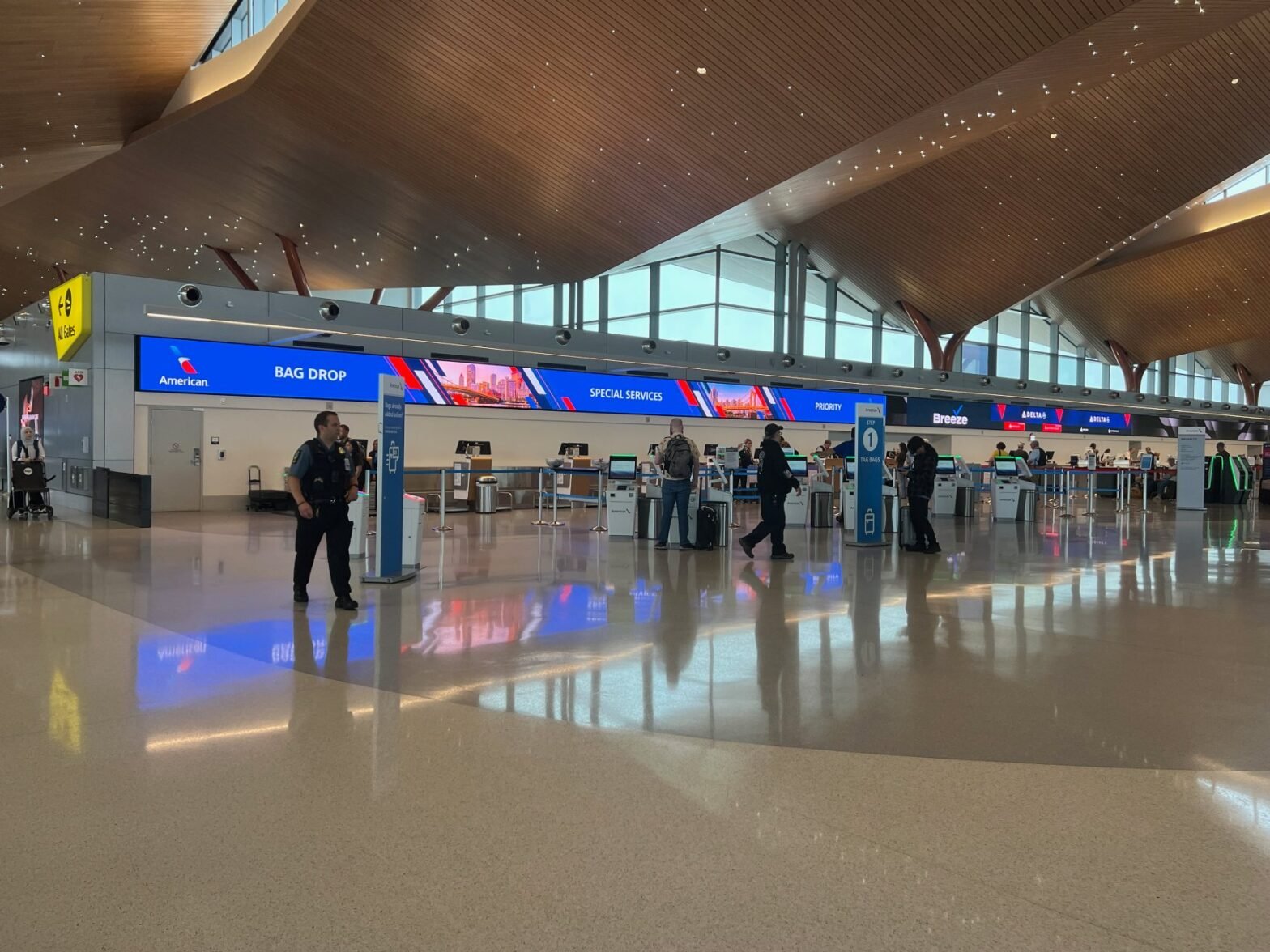
On September 29, an overflowing trash can served as a test case during a demonstration at Pittsburgh International Airport. A four-legged robot running software developed by Pittsburgh-based Skild AI showed reporters how it could identify the problem. Equipped with wheels on its legs, cameras, and sensors, the robot was being tested in a busy terminal where passengers and employees move through the same spaces. Skild robotics team member Robert Belle-Isle told Technical.ly that testing around real people would help the company understand how the machines behave outside controlled environments.
The demonstration is part of a six-month trial now underway at the airport. During the pilot, officials are examining whether the robots can collect information that helps staff respond to changing conditions across the terminal. Trash bins fill between cleaning rounds, spills require attention, and passenger activity varies throughout the day. The airport wants to know whether the robots can identify those conditions and report them to employees responsible for addressing them.
How Pittsburgh International Airport’s AI-Powered Robot Dogs Work
Pittsburgh International Airport is introducing up to four autonomous robots through a partnership with Skild AI. According to USA Today, one was already roaming the terminal by Oct. 14. The robots will operate in designated parts of the Airside Terminal, where passengers wait for flights after security. Each robot runs on Skild AI’s adaptive autonomy software, which uses cameras, environmental sensors, and AI-driven perception to navigate and identify unusual conditions.
The robots send collected information to airport operations staff, who decide where attention is needed. Custodial crews are among the employees the machines are expected to support during the trial. Indoor air-quality monitoring comes first, with one robot collecting readings as it moves through the terminal. Personnel will receive alerts when measurements fall outside defined parameters, as detailed in the airport’s official announcement. A later phase will test whether it can recognize spills, identify full or nearly full trash cans, and report congestion in crowded areas.
The project includes two charging stations and designated areas the robots must avoid. Skild AI will install and map the systems, supervise their use, and train airport employees. Belle-Isle also told Technical.ly that a company team member would monitor the robots during the pilot. Built-in sensors allow the robots to detect obstacles and stop when someone blocks their path.
What’s Next For Pittsburgh International Airport’s AI Robot Trial?
Airport officials are considering additional uses, although those features remain proposals. A later phase could involve BioFlyte, another company that has worked with the airport, equipping the robots with technology that can detect airborne biological threats. The airport is also examining whether autonomous machines could deliver food, drinks, or other items between designated locations.
The trial is part of Pittsburgh International Airport’s xBridge innovation program, which gives technology companies access to a working airport to test new products. Skild AI was founded in 2023 by Deepak Pathak and Abhinav Gupta, Carnegie Mellon University faculty members who now serve as the company’s chief executive and president, respectively.
Deepak Nayyar, the airport’s executive vice president and chief technology officer, said in the September announcement that officials want the technology to “work alongside our staff and airline partners to enhance efficiency, improve operations, and provide an additional level of customer service.”
Pittsburgh has already used xBridge to test other airport technologies, including autonomous floor-cleaning equipment and systems that estimate security wait times. Another current trial, developed with Arrow Analytics and Southwest Airlines, uses cameras to estimate how much overhead bin space remains as passengers board.