By 2 a.m. on Thursday, October 22, 2,000 visitors were waiting at the Great Temple of Ramses II at Abu Simbel, in southern Egypt, when Egypt Today reported that its doors opened. Some had spent the night in the area, while others arrived before sunrise with their phones ready to record an event that lasts only minutes. The crowd kept growing outside the entrance, beneath enormous seated statues carved into the rock more than 3,000 years ago. By morning, the crowd had grown to about 6,000 Egyptian and international visitors, according to Egypt’s State Information Service.
For those who made the early trip, the attraction was a specific moment inside the temple when the rising sun reached a chamber that normally receives no direct sunlight. The temple stands about 180 miles south of Aswan, close to the Sudanese border. The gathering also brought performers, local guides, and government officials to Abu Simbel, where the phenomenon has become a major event on Egypt’s tourism calendar.
Thousands Watch The October 22 Sun Alignment At Abu Simbel
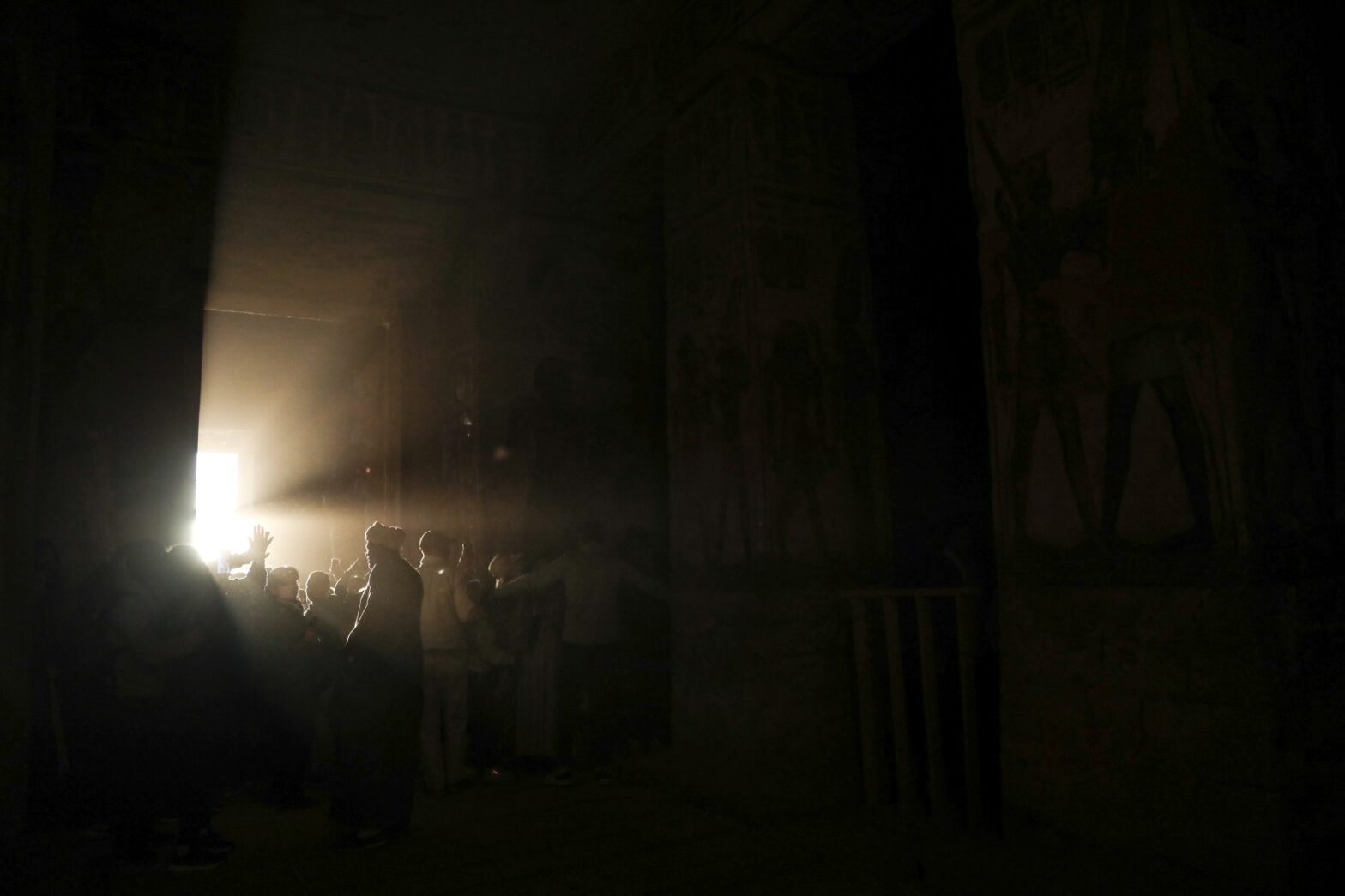
Sunlight entered the temple at 6:55 a.m. and illuminated its inner sanctuary for 22 minutes, ending at 7:17 a.m. The rays traveled roughly 200 feet through the entrance and stone halls, illuminating statues of Ramses II and the gods Amun-Ra and Ra-Horakhty. A fourth statue, representing Ptah, remained in shadow.
The solar alignment takes place twice a year, on October 22 and February 22. During Thursday’s gathering, tourists lined up before dawn to get inside. Local guide Hisham Khela told The Associated Press, “Today is a very special day, as you can see. It’s a celebration and a historic holiday.”
Attendance extended beyond those who reached the sanctuary. Around 3,000 tourists arrived at Abu Simbel International Airport on 10 flights since the previous day, Aswan Governor Amr Lashin said in the event’s official account. Authorities arranged crowd control and earlier access to ticket offices. The Aswan Culture and Arts Festival also featured folk performances, with seven regional groups taking part in celebrations surrounding the alignment.
A large screen outside the temple allowed visitors who could not reach the inner sanctuary to watch the event. Before the gathering, workers cleaned both temples and maintained the lighting, while organizers prepared golf carts for older visitors and people with disabilities, along with designated entry and exit routes.
Catch The Next Abu Simbel Solar Alignment In February 2027
The next alignment is expected on Monday, February 22, 2027. Egypt’s Ministry of Tourism and Antiquities confirms both annual dates and the date of the rock-cut Great Temple, commissioned by Ramses II, around 1264 B.C. The smaller neighboring temple honors Queen Nefertari and the goddess Hathor.
Four colossal seated figures dominate the Great Temple’s facade, although one collapsed in an ancient earthquake and its broken remains still lie nearby. Inside, standing statues of Ramses II line the main hall leading to the sanctuary.
People have traditionally associated the dates with the pharaoh’s birthday and accession to the throne, although The Associated Press describes these connections as beliefs. The alignment survived a major rescue operation in the 1960s, when workers dismantled and moved the temples to protect them from flooding associated with the Aswan High Dam. UNESCO now includes Abu Simbel within the Nubian Monuments World Heritage site, inscribed in 1979.
Visitors hoping to see February’s event should plan to arrive before sunrise and confirm special-event admission ahead of time. The ministry’s visitor page lists separate admission prices for alignment days, while the precise illumination time varies with atmospheric conditions. At the most recent February event, on February 22, 2026, Egyptian state media reported that sunlight reached the sanctuary from 6:22 to 6:44 a.m.